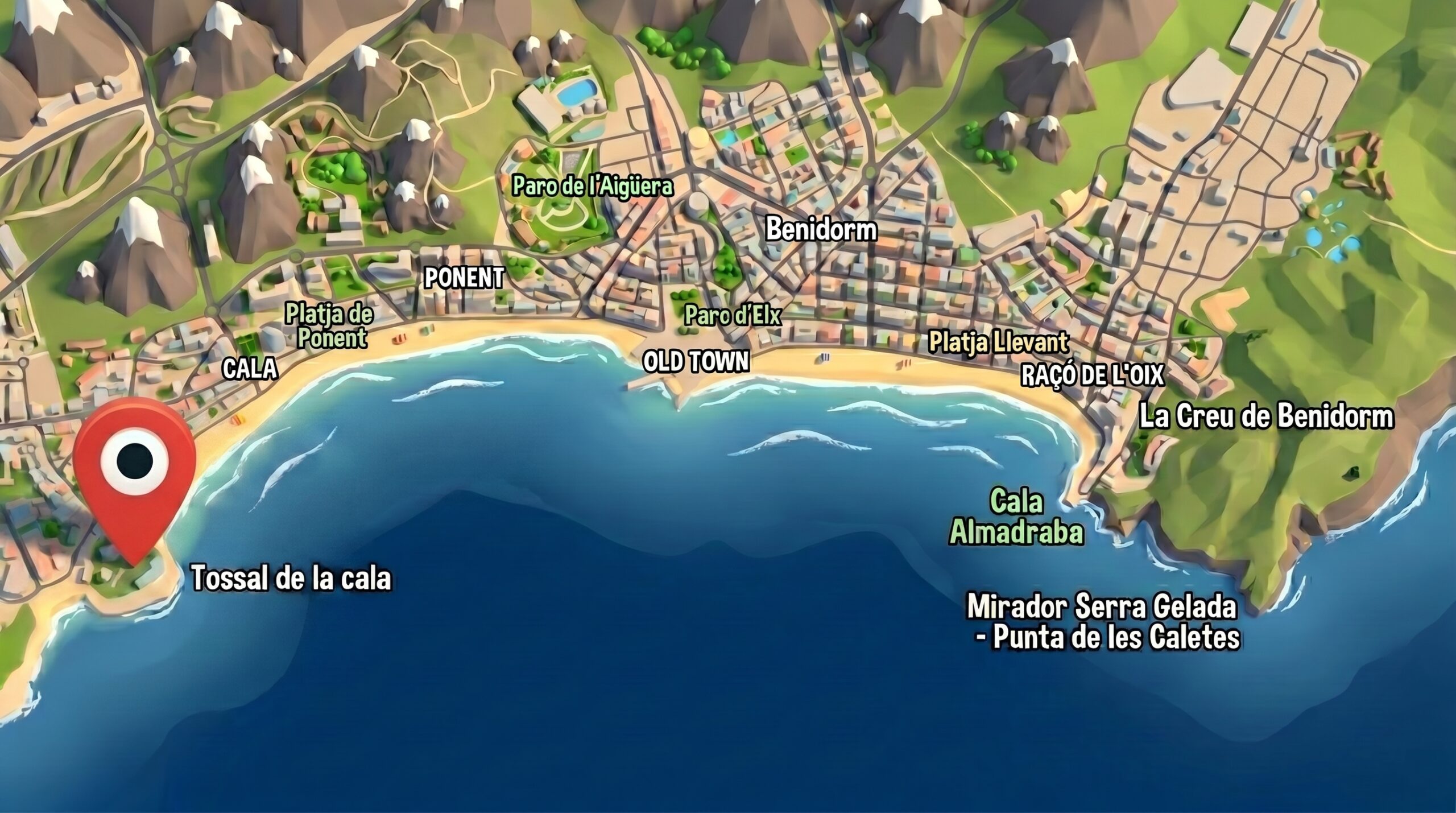
When you think of Benidorm, you probably see a forest of glass skyscrapers and bustling beaches. But did you know that beneath this modern cloak lies a history dating back to the times of Roman legions? At the very end of Poniente Beach, on the rocky hill of Tossal de la Cala, is a place that completely changes your perspective on this city.
Tossal de la Cala is not just ordinary ruins. These are the remains of a Roman fort (castellum), which was erected around 77 BC by General Quintus Sertorius.
At that time, the Roman Empire was torn by civil wars, and this hill served as a strategic observation point. The soldiers stationed at the fort had one goal: to watch the horizon for enemy ships and control movement along the Costa Blanca coast.
Thanks to recent archaeological work and revitalization (completed and fully opened in the mid-2020s), Tossal de la Cala has become a modern open-air museum.
Barracks foundations: You can walk along the outlines of the former rooms where Roman legionnaires lived.
Defensive walls: To this day, fragments of the walls that once protected the fort from land attacks have been preserved.
Virtual reconstructions: On-site, you will find information boards with QR codes that allow you to see on your phone screen what the building looked like in its glory days.
| Feature | Information |
| Period of origin | 1st century BC (Sertorian Wars) |
| Function | Military observation fort (castellum) |
| Location | Hilltop above La Cala (end of Poniente) |
| Visiting time | approx. 45–60 minutes |
| Entry fee | Free |
Even if you are not a fan of archaeology, Tossal de la Cala should be on your list for one reason: the view.
The most spectacular panorama of all of Benidorm unfolds from the hill. On one side, you see the blue of the sea and the island of L’Illa de Benidorm, and on the other – the entire coastline with a forest of skyscrapers that seem unreal from this perspective. It is the perfect place for photos during the “golden hour.”
Fun fact: Archaeologists found not only walls here, but also everyday objects: coins, dishes, and even dice that Roman soldiers used to pass the time during long watches.
The hill is located on the border of Benidorm and Finestrat (La Cala district).
On foot: A short but quite steep walk uphill along Calle de la Ermita awaits you. It is worth wearing comfortable shoes!
By bus: Lines number 2 and 3 will take you near the foot of the hill.
For whom: For everyone who wants to escape the crowds on the beach and feel a breath of history.
Summary:
Tossal de la Cala is proof that Benidorm has a soul much older than the concrete foundations of its skyscrapers. It is a place where antiquity meets a futuristic skyline – a must-see for every conscious tourist in 2026.