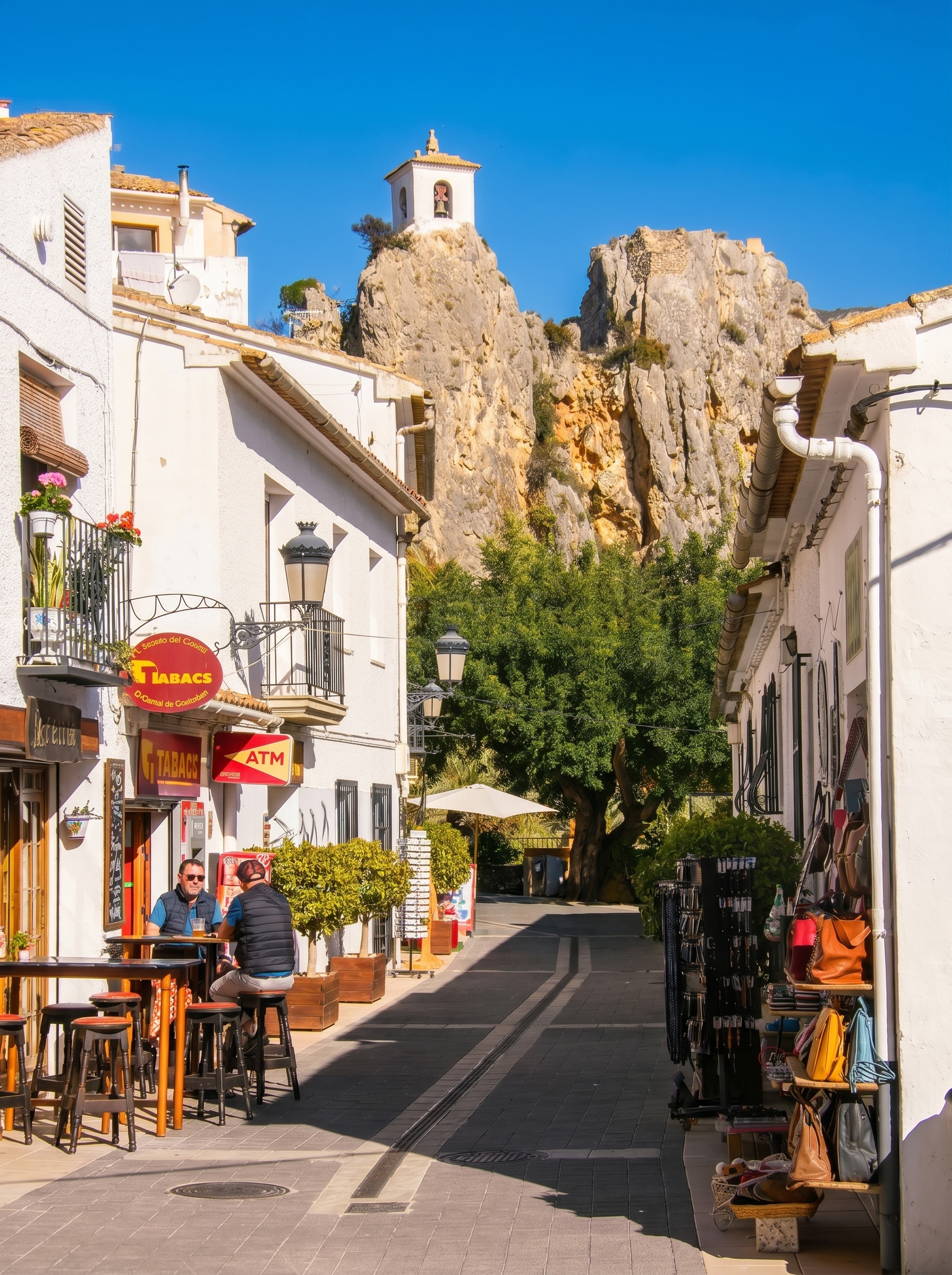
El Castell de Guadalest, commonly known simply as Guadalest, is a spectacular, small village located in the heart of the Alicante province. For decades, it has been recognized as one of Spain’s most precious tourist jewels. This magical place, included in the elite list of Los Pueblos Más Bonitos de España (The Most Beautiful Villages of Spain), attracts crowds of travelers every year, even though its permanent population hovers around just 200 people. Every day, this intimate settlement comes to life as its steep, cobbled streets fill with guests from all over the world, eager to feel the atmosphere of centuries past and admire architecture seamlessly integrated into raw nature.
The secret of Guadalest’s uniqueness lies in its almost surreal scenery. It is a true “eagle’s nest” perched on the vertical walls of limestone cliffs that dominate the entire surrounding area. It is a fascinating amalgam of history—from strategic Moorish fortifications to the Christian heritage of the Reconquista—intertwined with a surprisingly rich and peculiar collection of surrealist museums that are unparalleled in all of Europe.
Guadalest occupies a strategic and incredibly picturesque spot in the heart of the valley of the same name, serving as a gateway to the highest mountain peaks of the Alicante province. The town is nearly besieged by monumental massifs: to the south, the mighty Sierra d’Aitana (1,558 m), the region’s highest peak, and to the north, the scenic Sierra de la Xortà and Sierra de Serrella. This location creates a specific microclimate, ideal for Mediterranean vegetation.
The journey to Guadalest is a spectacle in itself—the access road winds through landscapes that change with every kilometer. Travelers pass endless olive groves, terraced almond orchards that cover the valley in white and pink fuzz in early spring, and vast orchards of loquats (níspero). It is worth noting that this region, along with the nearby town of Callosa d’en Sarrià, is the largest producer of these golden fruits in all of Spain, and their quality is protected by a Protected Designation of Origin (D.O.P.).
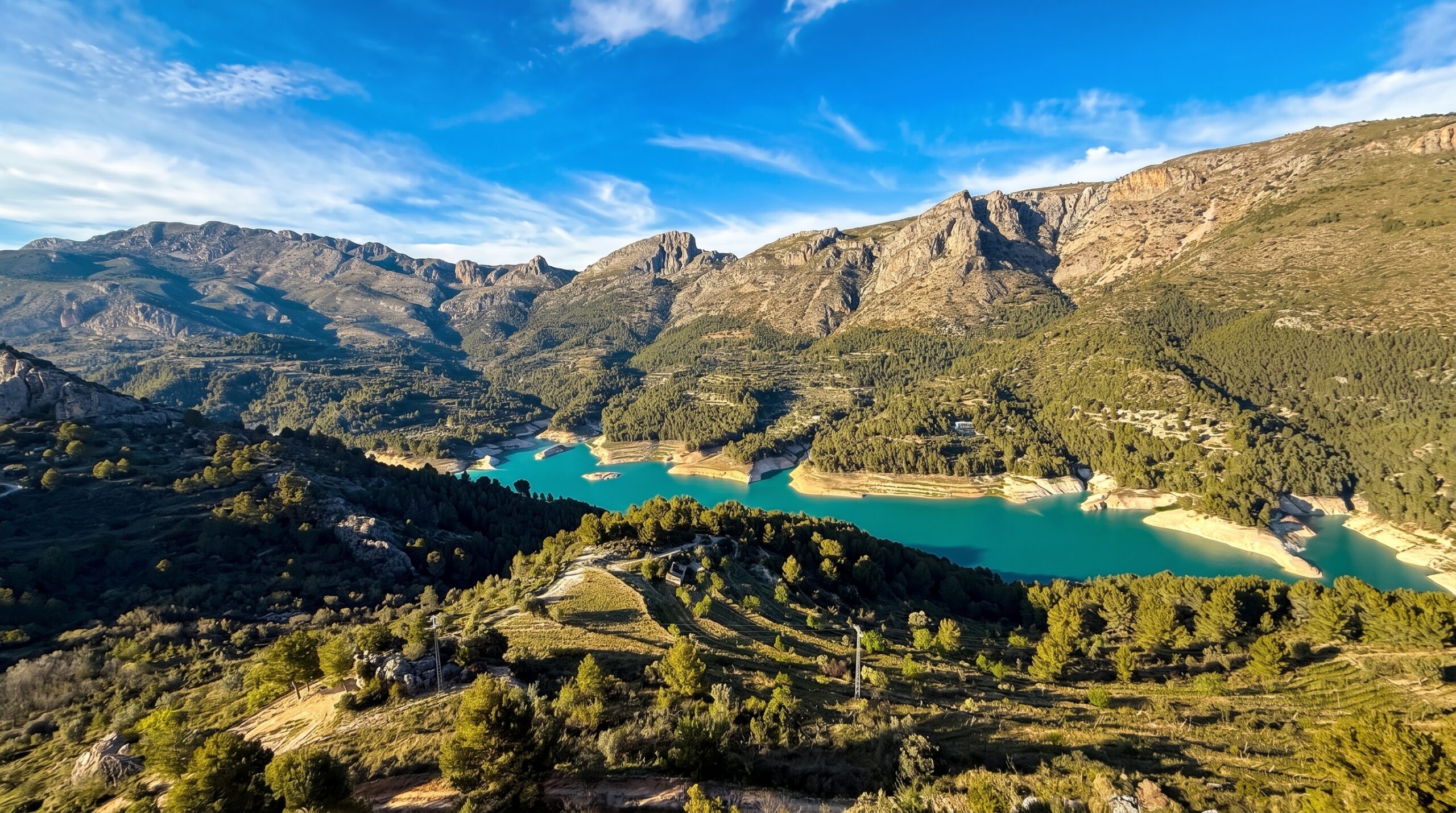
As you approach the destination, the icon of the region catches the eye: the solitary, white bell tower (Peñon de la Alcalá). Built on top of an inaccessible, vertical rocky spire, it looks as if it were placed there by a giant, defying the laws of gravity. Once part of the Alcozaiba castle’s defense system, the most electrifying sight for visitors appears only after passing through the San José tunnel or from the castle’s observation decks. Below the village lies the Embalse de Guadalest—an artificial reservoir built in the 1960s. Its surface takes on an unreal, saturated turquoise or emerald color, thanks to the purity of the mountain waters and the specific mineral composition of the ground. The contrast between this intense water color, the raw gray mountain slopes, and the lush green of the pines creates one of the most photogenic panoramas in all of Spain.
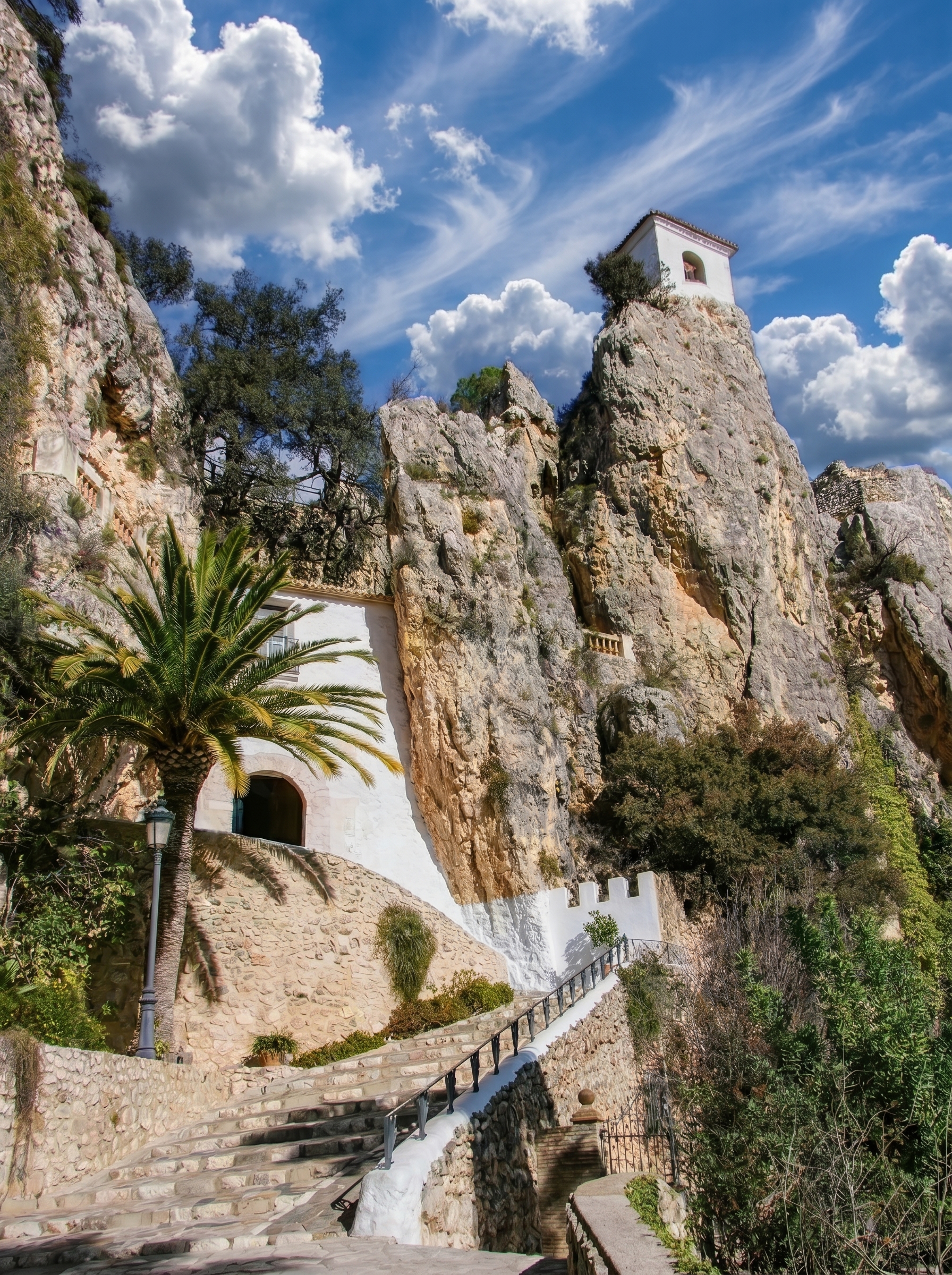
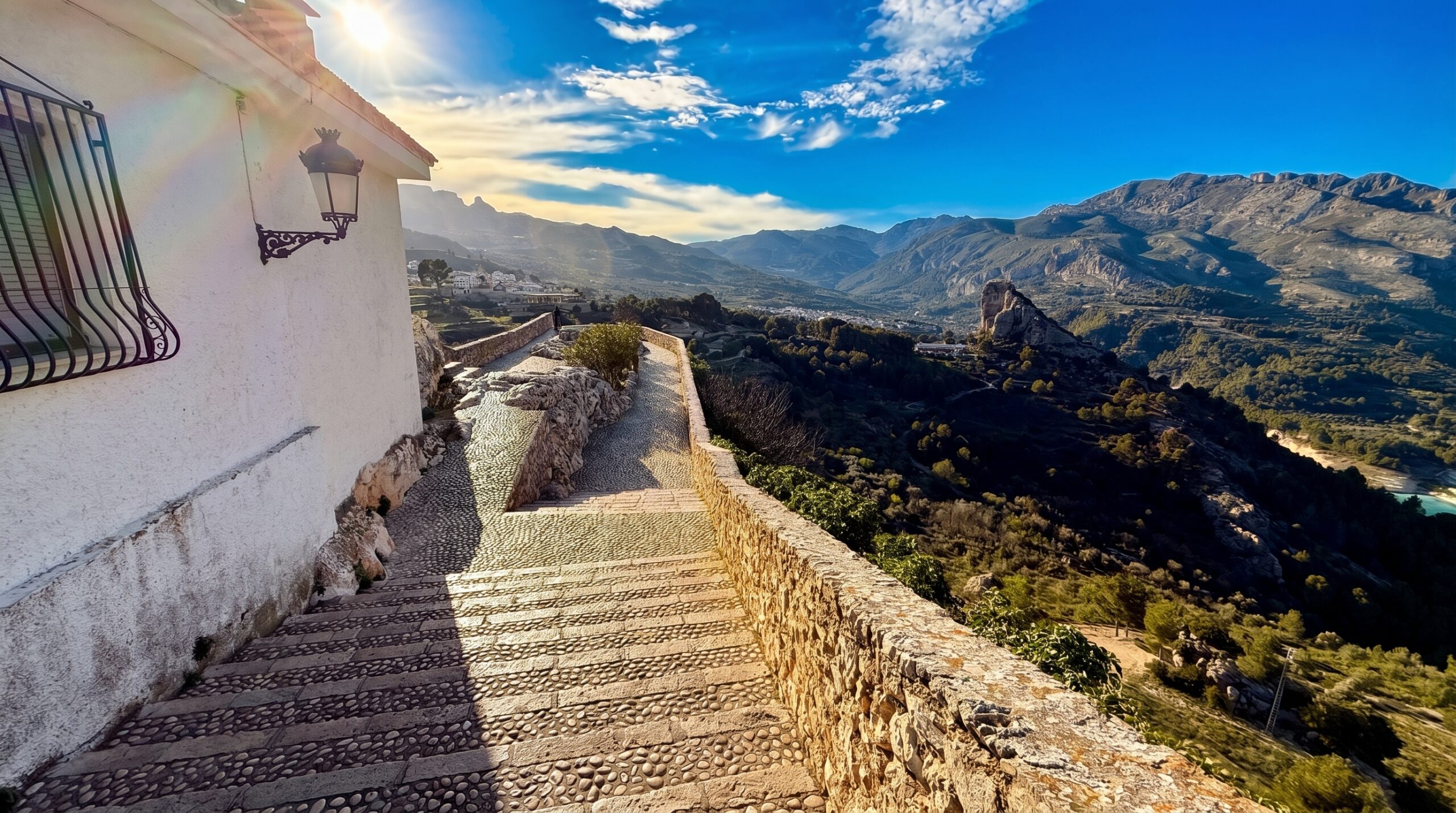
The history of Guadalest is a chronicle of survival, where nature and human engineering intertwine. The origins of settlement date back to the period of Muslim dominance on the Iberian Peninsula. In the 11th century, the Moors of the Almoravid dynasty recognized the unique defensive potential of the local rocks and erected a fortress designed to control trade routes leading inland. The site was designed to be absolutely inaccessible – the only path to the upper part of the village and the castle led through the Portal de San José, a tunnel several meters long, painstakingly carved into solid rock. Thanks to this solution, a handful of defenders could effectively hold off an entire army.
In 1248, as part of the Christian Reconquista, the forces of James I the Conqueror took control of the valley, although the Moorish population remained here for centuries as farmers (Moriscos). The castle became an important point in the estates of the Crown of Aragon, and in 1293, James II the Just granted it to the Sarrià family. Subsequent centuries brought numerous changes of ownership, including the noble families of Cardona and Orduña, who managed the settlement until the mid-20th century. A key, though tragic, demographic moment was the expulsion of the Moriscos in 1609, which led to temporary depopulation and the economic decline of the region.
However, the real challenge for Guadalest was not armies, but the power of nature and unfortunate coincidences:
Despite all these disasters, what has survived – the walls climbing the cliffs, the bell tower balancing on the precipice, and the stone houses clinging to the rock – creates an amazing, mystical atmosphere of a “city suspended in the clouds,” which has been officially recognized as a historical-artistic site since 1974.
This is the main landmark and the heart of historical Guadalest. This fortress, also known as the Royal Castle, rises on the highest point of the rock. Although centuries and natural disasters have left mostly fragments of walls and foundations today, entering its grounds remains a must. Walking among the ruins, you can see the remains of ancient water cisterns and observation towers. The greatest reward for the climb, however, is passing through the old cemetery located at the very top – it is one of the most extraordinary burial places in Spain, offering an absolutely unrivaled 360-degree view of the entire valley, the azure lake, and the rugged ridges of the Sierra d’Aitana.
This building, erected after the great earthquake of 1644, served as the residence of the Orduña family, who for centuries acted as governors and trusted associates of the Cardona family. Now converted into a museum, the house allows you to travel back in time to the 18th and 19th centuries. Visitors can admire richly decorated dining rooms, period bedrooms, a traditional kitchen, and an impressive library of over 1,200 volumes. Casa Orduña also plays a key role in the logistics of the visit – it is through its interior that the only staircase leading up to the ruins of San José Castle passes.
This 18th-century Baroque temple, located in a small square right next to Casa Orduña, impresses with its noble simplicity. The church was built on the foundations of a former mosque, which is typical for regions reclaimed during the Reconquista. The interior, though more modest after the damage of the Spanish Civil War, still radiates peace and solemnity. Interestingly, its bell tower is not directly attached to the main body of the building but is located on a neighboring rock spire, causing the sound of the bells to carry exceptionally clearly throughout the valley.
Guadalest has earned the title of “city of museums” because in such a small area there are as many as eight of them, and each presents collections that would be the envy of the world’s largest metropolises. Here are the most fascinating ones:
For travelers seeking an escape from the hustle and bustle of the tourist center, the valley offers an oasis of peace in the form of a turquoise lake. Descending from the town along the winding path known as Camino de la Presa takes about 20 minutes and allows you to see Guadalest from a completely different perspective – as an impregnable fortress towering over a precipice.
The main attraction for active visitors is the picturesque hiking trail (partially marked as PR-CV 199), which forms a loop around the entire reservoir. The route is about 10 km long and relatively easy, though it requires comfortable footwear due to the gravel surfaces. Wandering in the shade of pines and cork oaks, you can admire the play of light on the water’s surface. Its unique, almost neon shade of turquoise results from high mineral content and limestone sediments that scatter sunlight in a specific way.
Worth knowing:
Getting to Guadalest from the popular Costa Blanca resorts is simple and very scenic. From Benidorm, the journey by car via the CV-70 route takes about 25 minutes. However, bear in mind that the road is winding and requires concentration. For those without their own transport, the ideal solution is local bus line 16 (Llorente Bus), which runs regularly from Benidorm, offering an affordable alternative.
In the village itself, parking can be a challenge, especially on weekends. There are two main paid parking lots at the foot of the old town (Parking 1 and Parking 2). It is recommended to arrive early in the morning (before 10:30 AM) to avoid crowds and find a spot easily.
The timing of your visit significantly impacts your experience of Guadalest:
Guadalest’s gastronomy is the quintessence of the mountain cuisine of the Alicante region. It’s worth venturing away from the main squares to find small family restaurants serving:
Guadalest is a place where time seems to slow down, and echoes of ancient civilizations still resonate in the stone walls. While it is a magnet for tourists today, its heart remains unchanged – the raw majesty of nature and an indomitable history that makes every visit to this “pearl of Alicante” a journey not only through space, but also through time. It is a mandatory stop for anyone wishing to discover the true, deep face of the Spanish Levant.